Home/Birds
Bird Removal in Valdosta
Almost every native bird is protected by federal law, active nests included, so what is legal depends on the species.
The canopy loss cuts both ways here. A great many natural nesting cavities went down with the trees, and birds that would have used them are now looking at vents, gable louvres and the gaps left where roof detail was damaged. Nearly all native birds are federally protected, so an active nest in a vent is a legal problem as well as a blocked vent.
Birds in Lowndes County: who does what
Lowndes County Animal Services lists removal of rabies vector animals from inside the home among the services it provides, and refers broader human-wildlife conflict to UGA Extension. That is a genuinely different answer from most Georgia counties, where the county will not touch wildlife at all. It is worth knowing the limit of it: that covers the bat loose in your bedroom or the raccoon in your kitchen. It does not cover the colony in your roof, and it is not an exclusion; nobody is sealing the hole it came through.
For identifying an animal or damage before anyone is paid to look, the UGA Extension, Lowndes County office is at 2102 East Hill Avenue, Valdosta, GA 31601, 229-333-5185 (office page).
What Georgia law says about birds
All native birds are federally protected under the Migratory Bird Treaty Act; house sparrows, European starlings, pigeons and monk parakeets are non-native and unprotected. Georgia DNR cannot authorize taking woodpeckers, hawks, owls, vultures or other federally regulated birds, and even one damaging woodpecker needs a federal permit for lethal control. All Georgia rules →
Sources: UGA Extension B1248: resolving human-nuisance wildlife conflicts; Georgia DNR: Nuisance Wildlife Control study material (O.C.G.A. 27 and permit conditions); Lowndes County Animal Services, Services Provided. Checked October 2026.
Signs, and why they matter
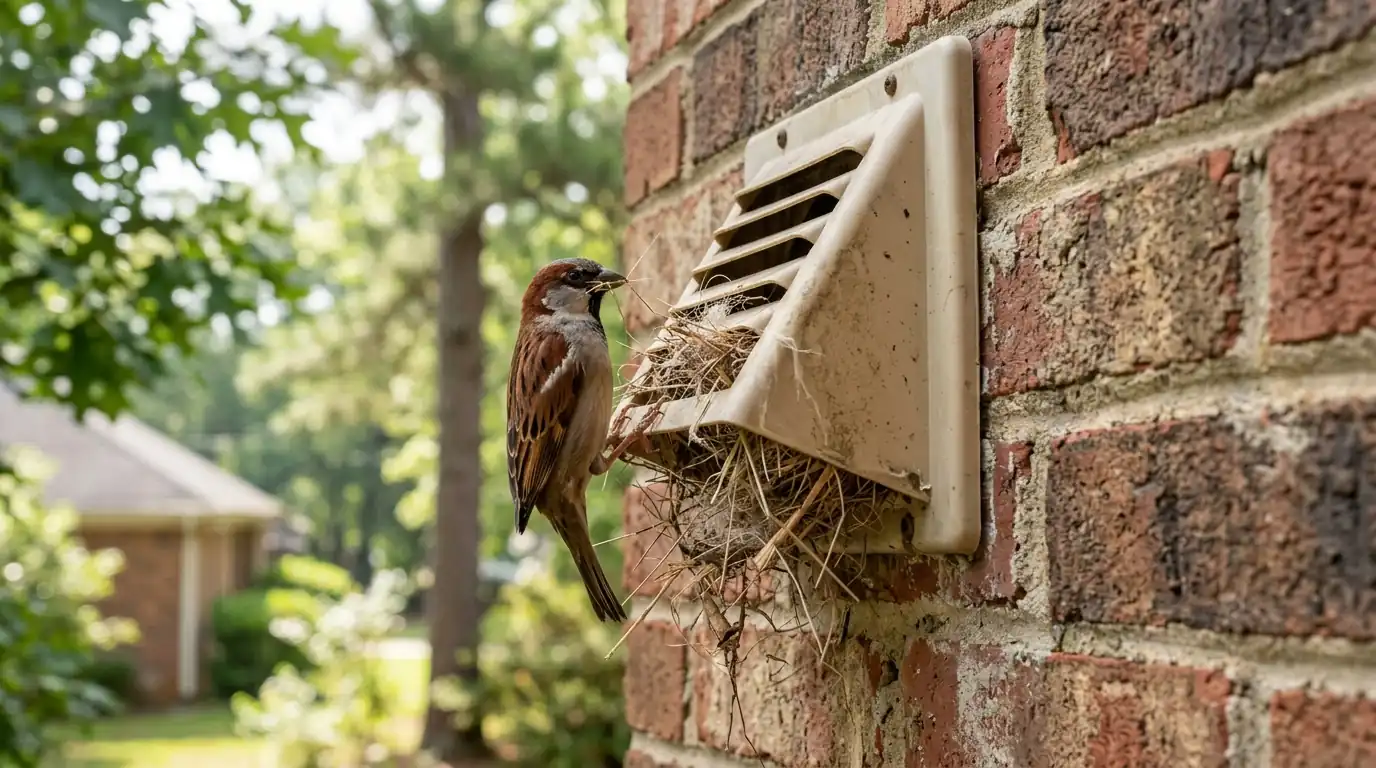
- Chirping from a bathroom fan, dryer vent or kitchen exhaust
- Nesting material poking from a vent hood or dormer gap
- A dryer that has stopped venting properly: a real fire risk
- Blocked dryer vents are a documented cause of house fires
- Droppings carry histoplasmosis and cryptococcosis
How removal works
Identify the species first, because that determines what is legal. Where removal is permitted, the nest is cleared, the duct or vent cleaned, and a purpose-made vent guard fitted so it cannot be renested. Where the species is protected and the nest is active, the lawful answer is to wait, then exclude.
Bird questions
How much does bird removal cost in Valdosta?
$200 – $600 depending on access, depending on access and whether young are present. After a long stay in an attic the cleanup is often the bigger bill (attic restoration).
Is there a wrong time of year to deal with birds?
Spring and early summer nesting is the peak, and also the period when an active nest is most likely to be legally protected.
Request a quote
We read every request and pass it to a licensed wildlife operator covering Valdosta where one is available. We are still building our list of operators here, so we cannot promise one is available or say how quickly they will respond.